Tessera for Windows
ACP-240 · STANAG 4774 · STANAG 4778 · ADatP-5636 — file-level encryption with ABAC policy embedded and cryptographically bound, enforced in real time at the moment of decryption against the requester's clearance attributes.
Traditional network-perimeter security works well when all sensitive work happens inside a controlled boundary. In practice, that boundary is constantly crossed: files are shared with coalition partners, archived on removable media, sent by email, or moved to systems outside the organisation's direct control.
When a file leaves the perimeter, it leaves behind the access controls that were protecting it. At that point there is nothing stopping an unauthorised recipient from reading it — or an authorised one from forwarding it further.
.ztdf archive can only be decrypted by a Key Access Service that
has evaluated the requester's attributes against the embedded access policy.
The policy enforces itself regardless of where the file travels.
Three phases, standards-defined at every step.
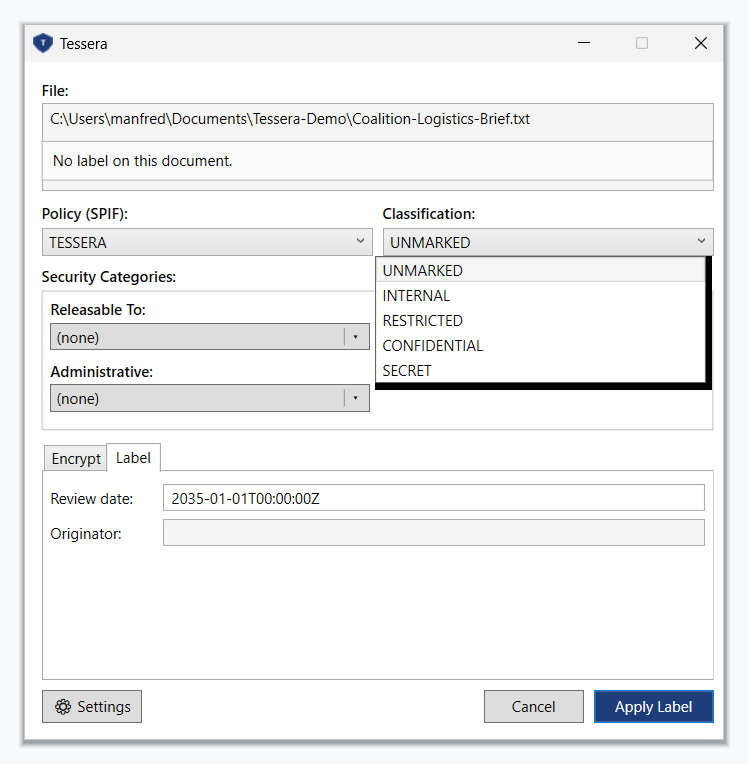
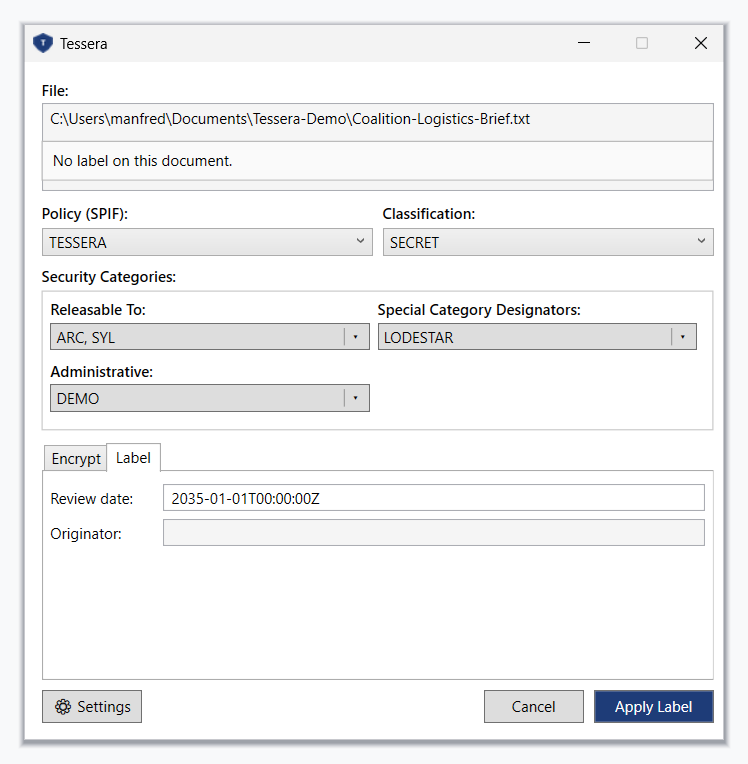
The file is encrypted with AES-256-GCM. A unique Data Encryption Key (DEK) is generated per file, then wrapped with the KAS public key using RSA-OAEP-SHA256. The ABAC access policy — classification level and releasability attributes from the STANAG 4774 label — is bound to the DEK with an HMAC and stored in the manifest. The STANAG 4778 Binding Data Object (BDO, CMS SignedData) ties the label to the content with a digital signature.
The result is a .ztdf archive — a ZIP container holding the
encrypted payload, the manifest (policy + wrapped DEK), and the STANAG 4774
Confidentiality Label with its ADatP-5636 Object Classification Label (OCL). The archive is
completely self-describing. It can be stored, forwarded, archived, or
transferred to any other system — the access policy travels with it and
cannot be stripped without invalidating the signature.
When a user attempts to open the file, the local Tessera service sends a rewrap request to the Key Access Service. The KAS verifies the STANAG 4778 binding, evaluates the embedded ABAC policy against the requester's clearance attributes (from the identity token), and either releases the DEK or returns a denial. Decrypted content is never written to disk — it is held in memory only, through a virtual file system driver.
Tessera for Windows is a layered system. The Windows-side components handle the user experience and local operations. The backend components handle identity, policy, and key management.
The local service runs as a Windows service and exposes a local API. Office add-ins and the Explorer context menu communicate exclusively with the local service — they never contact the KAS or management service directly. This means the backend can be deployed in an isolated network segment without exposing it to the desktop.
The Key Access Service is stateless: it holds only the KAS private key (used to unwrap the DEK) and its SPIF-driven policy. No plaintext is ever stored or logged. The management service holds audit records and KAS configuration, but never holds decryption keys.
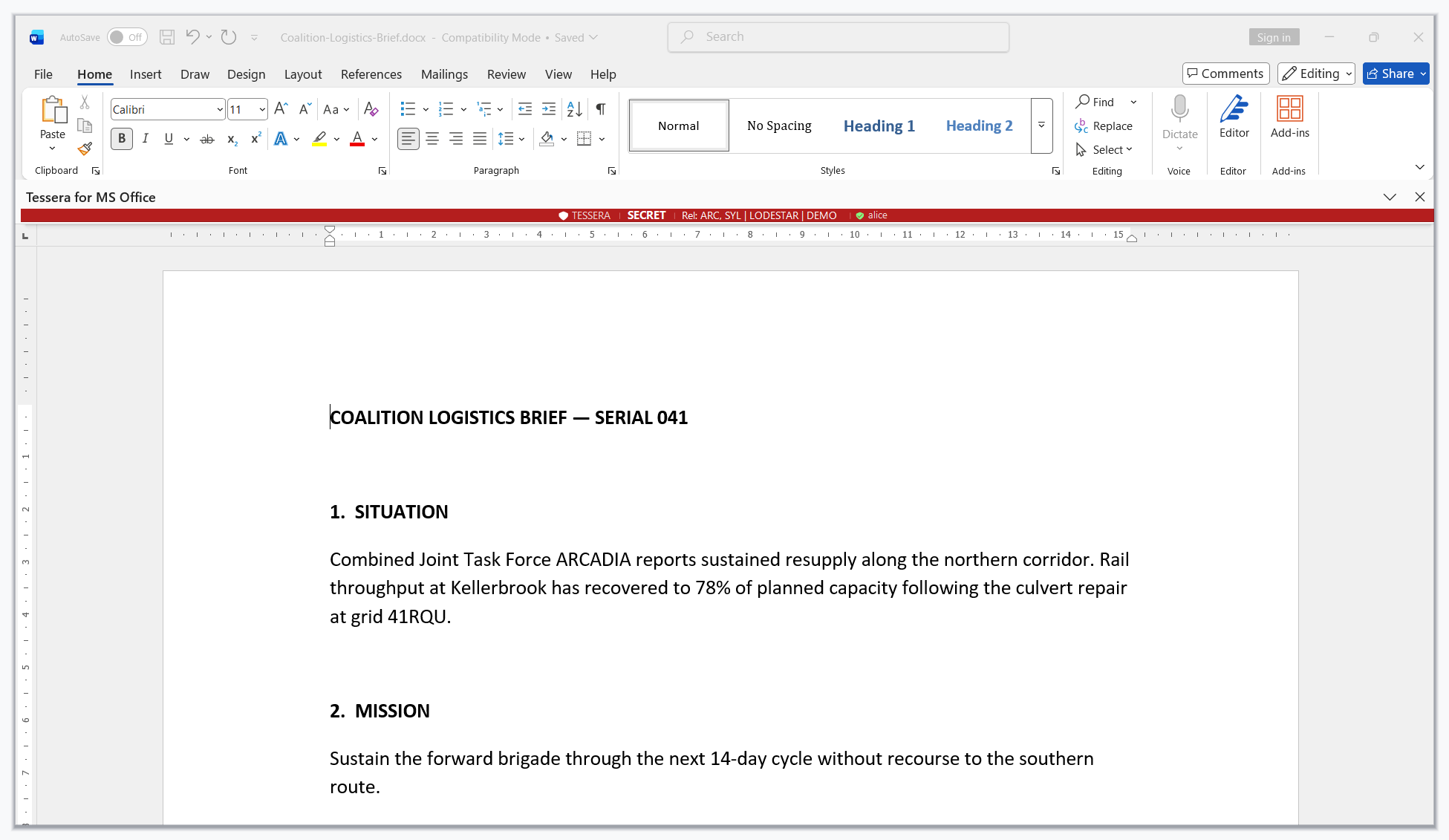
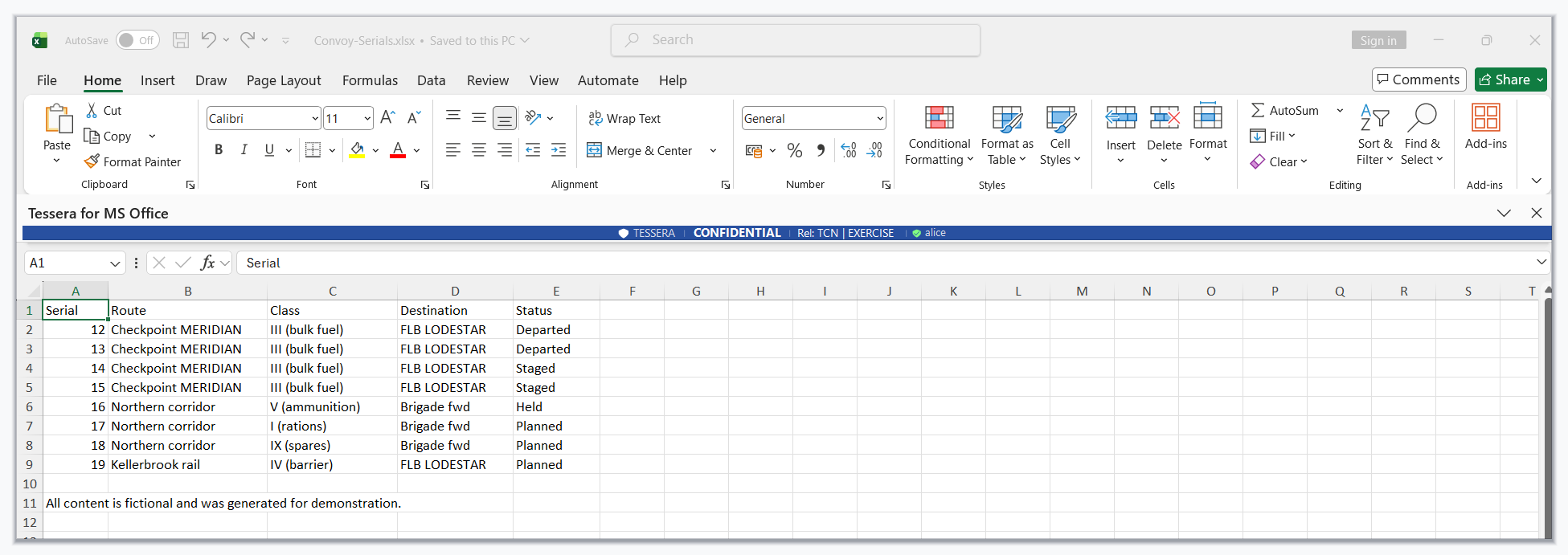
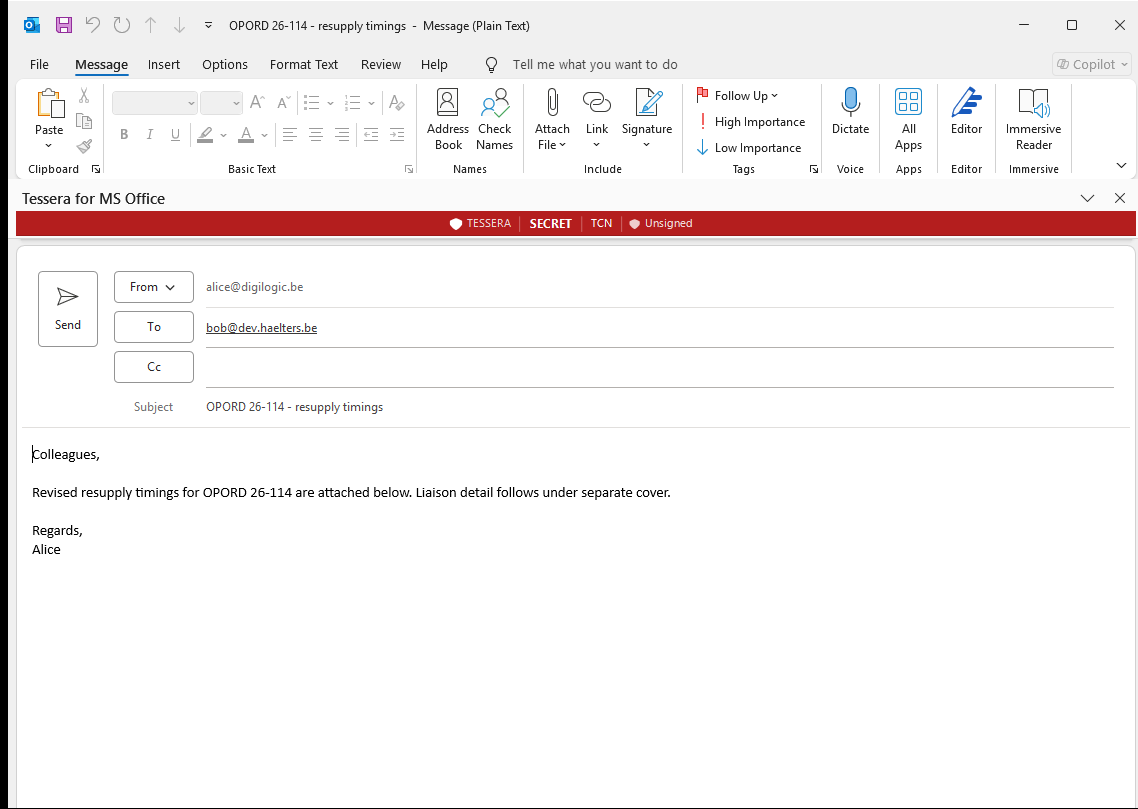
VSTO add-ins for Word, Excel, PowerPoint, and Outlook. Integrate classification label selection, document protection, and label-aware send enforcement into the native Office ribbon. Outlook enforces that emails carry a valid label before sending.
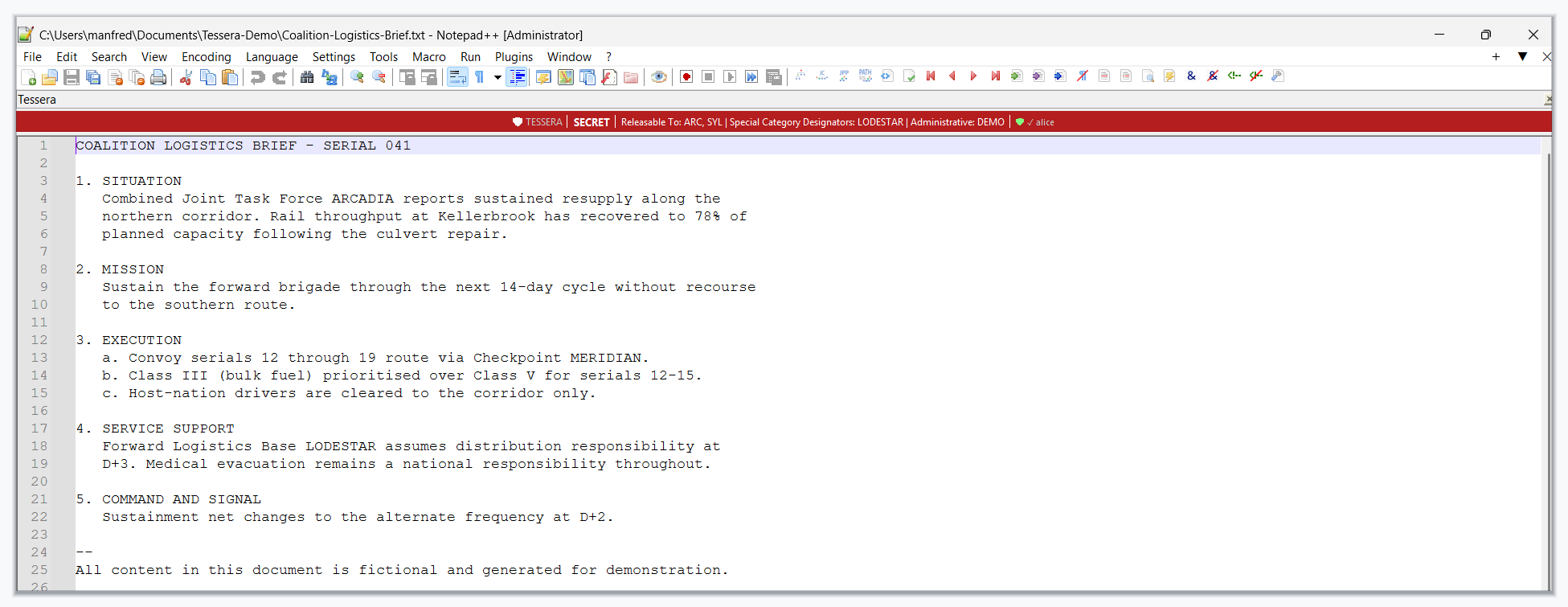
Context-menu entries for Protect with Tessera and Open Tessera File
on any file type. Enables .ztdf encryption and transparent decryption
without leaving the Windows shell.
A Windows service that orchestrates all local operations: encryption, decryption, label construction, DSIG verification, KAS communication, and the SPIF-driven attribute URI mapping. The single point of contact for all Windows-side components.
Server-side service implementing the ACP-240 KAS role. Holds the KAS RSA private key, evaluates ABAC policies derived from the embedded SPIF, and releases Data Encryption Keys only after positive policy evaluation. Supports multi-domain scenarios with domain-scoped ABAC.
Web application providing operator access to KAS configuration, user management, domain and SPIF administration, policy review, audit log, and PKI certificate management. Secured with OIDC.
OIDC identity provider. Stores user clearance attributes (classification level, category authorisations) as claims issued in the JWT access token that the KAS validates on every key-release request.
The .ztdf archive format and key-access protocol.
XML Confidentiality Label schema; classification level and categories.
CMS SignedData label-to-content binding; ADatP-4778.2 profiles for OOXML, XMP, and sidecar.
JSON OCL record; portioning marking strings, document-level and portion-level marks.
SPIF parsing for policy-driven attribute URI mapping and ABAC.
JCS-canonical form for deterministic HMAC computation over manifest.
Standards implemented in Tessera for Windows
ACP-240 STANAG 4774 STANAG 4778 ADatP-5636 XMLSPIF v2.1/v3.0 RFC 8785 JCS RFC 5652 CMS