
Tessera
Standards-Compliant Data Security Solutions
Data-centric file protection and controlled cross-domain exchange for classified and sensitive environments — built to ACP-240, STANAG 4774, STANAG 4778, and ADatP-5636.
Standards-Compliant Data Security Solutions
Data-centric file protection and controlled cross-domain exchange for classified and sensitive environments — built to ACP-240, STANAG 4774, STANAG 4778, and ADatP-5636.
Tessera implements NATO's and CCEB's data-centric security model — where the protection is embedded in the data itself and travels with it regardless of where it goes.
Encryption and ABAC policy are embedded directly in the
.ztdf archive. Every decryption request is evaluated in real time
by the Key Access Service against the requester's clearance attributes —
classification level, categories, and COI membership. No key is released unless
every policy condition is satisfied, regardless of where the file is stored or
transferred.
Information crossing between security domains is evaluated against both domain security policies simultaneously. Every flow passes through a Guard — the only permitted path — with fail-closed enforcement and a full audit trail.
All components are designed against ACP-240, STANAG 4774, STANAG 4778, ADatP-5636, and XMLSPIF. Security labels are digitally signed per ADatP-4778. Interoperability with CWIX is tested using published test vectors.
Two complementary solutions addressing different aspects of the classified information lifecycle — protection at rest and controlled exchange in transit.
A standards-compliant Data-Centric Security solution for the Windows desktop.
Files can be cryptographically bound with a STANAG 4774 Confidentiality Label
and encrypted into .ztdf archives with classification and access policy
embedded — enforced at the moment of decryption by a Key Access Service.
A STANAG-compliant Cross-Domain Solution (CDS) — a bi-directional security gateway mediating controlled information exchange between classification domains. Every information flow is evaluated against both domain security policies; no content passes without Guard approval.
Traditional perimeter security protects a network boundary. Once data leaves that perimeter — shared with a partner, archived, or transferred to another domain — the protection is gone.
The NATO data-centric model inverts this: the protection travels with the
data. A .ztdf archive is an encrypted package whose access
policy is embedded and cryptographically bound to the encrypted payload. No key is
ever released without a real-time policy check against the requester's attributes.
Security labels (STANAG 4774) declare the sensitivity of the information. Binding assertions (STANAG 4778) tie those labels to the content with a digital signature that cannot be stripped or replaced without detection.
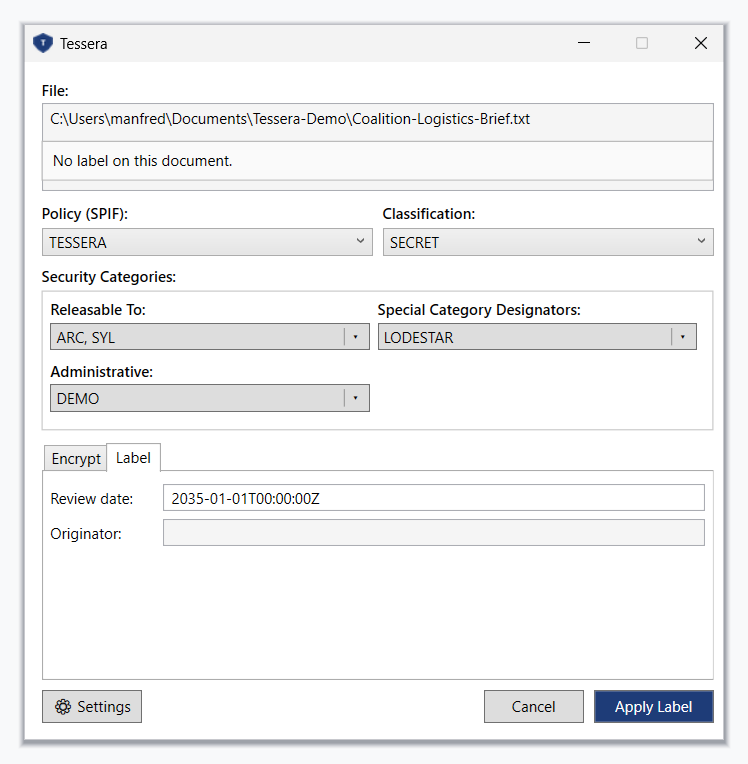
Read: How security labels workNothing about the classification vocabulary is built into the software. The levels, the order they rank in, and the categories allowed to qualify them are read from the domain's XMLSPIF — the machine-readable form of the security policy that the policy authority publishes.
Point the desktop at a different policy and the whole interface changes with it: different levels, different releasability groups, different compartments. That is what makes one product deployable in a national domain, a coalition mission network and a partner enclave without a rebuild.
Shown here with TESSERA, a fictional policy we publish for demonstration and testing — so nothing in the screenshot is a real classification marking.
Our concepts guide explains classification levels, clearances, categories, SPIFs, and multi-point enforcement — starting from physical-world analogies and building up to the NATO standards that implement them electronically.
How Security Labels Work